PRODUCT
Post-quantum readiness scanning for TLS
Cipherscan checks the algorithms your TLS services actually negotiate, and tells you which ones are already approved post-quantum and which ones still rely on classical cryptography. Run a free check with no signup, or create a free account to scan multiple domains automatically and get a readiness score you can track.
TLS 1.2
TLS 1.3
What is Cipherscan?
Cipherscan is a free tool that checks TLS services for approved post-quantum cryptography algorithms, the ML-KEM and ML-DSA algorithms NIST standardized as FIPS 203 and FIPS 204 in August 2024, versus classical algorithms that remain vulnerable to future quantum computers. Point it at your public TLS endpoints, or download the CLI for infrastructure that isn’t publicly reachable, and it reports which negotiated algorithm was used, host by host.
Cipherscan today covers TLS algorithm discovery. It is a focused starting point for PQC exposure, not a full cryptographic inventory platform, don’t expect it to catalog cryptography embedded in application code or third-party libraries.
Who it's for
Built for the teams evaluating PQC exposure directly, not consumers.
What the report contains
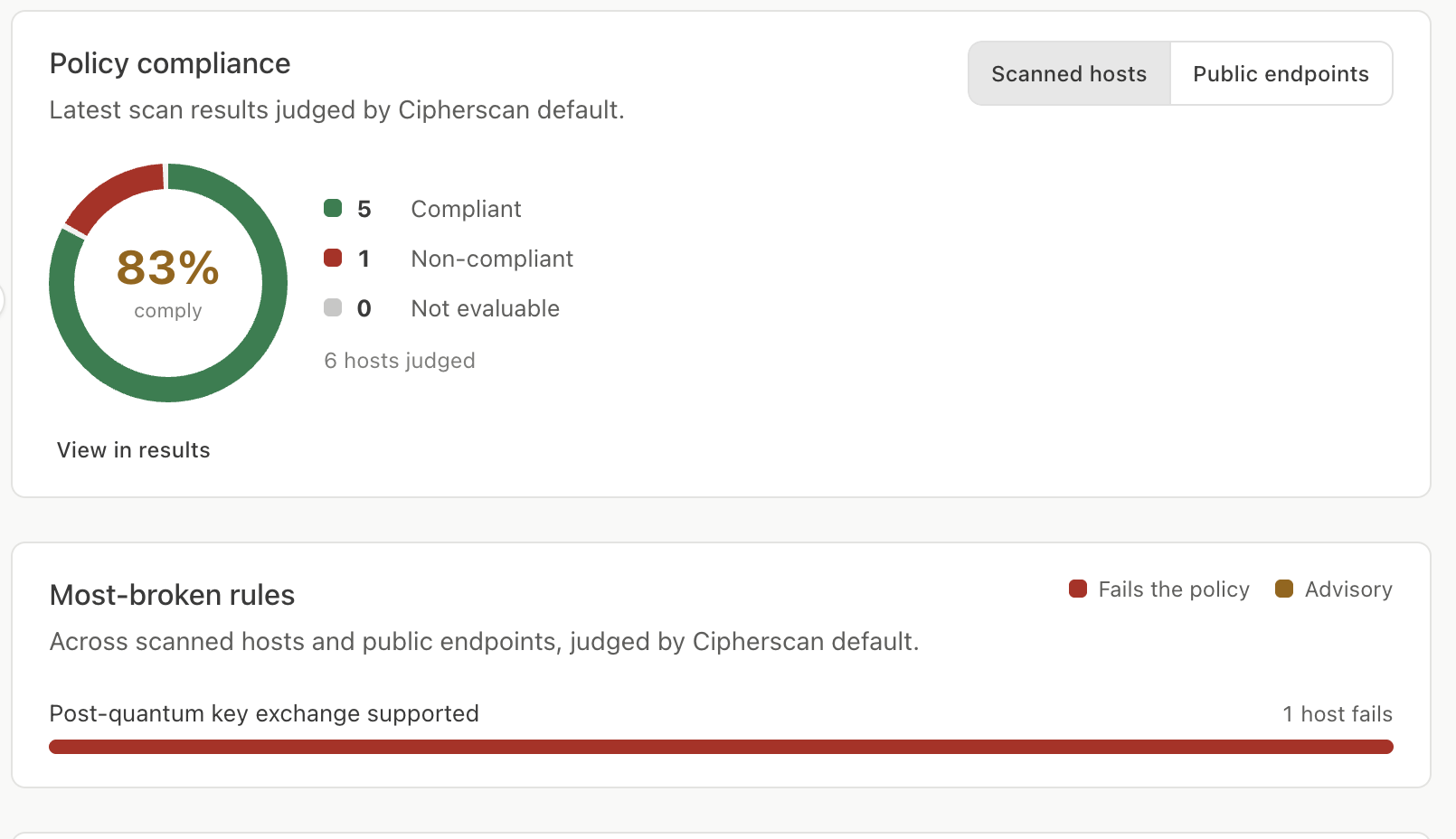
Every scan produces a per-host pass or fail status and one overall PQC-readiness percentage, whether the host was scanned automatically or uploaded from a private-network CLI run.
Current limitations
- Covers TLS handshake algorithms only, not other protocols.
- Not a full cryptographic inventory platform, it doesn't scan application code or embedded libraries.
- Hosted scanning on the free plan is limited to 5 domains at a time.
Free, and what a free account unlocks
Hosted scanning
Cipherscan automatically scans up to 5 of your public domains, no install required.
Private network scanning
Download the same free CLI to check infrastructure that isn’t publicly reachable, then upload results to your account.
See your own PQC exposure
Want to see this on a real domain first?
Written by the team behind Anvil Secure.