Ciphersound for compliance and risk teams.
Ciphersound gives compliance and risk teams one readiness percentage, built from what your servers actually negotiate, not from a questionnaire. Fix a host, run it again, and the number moves.
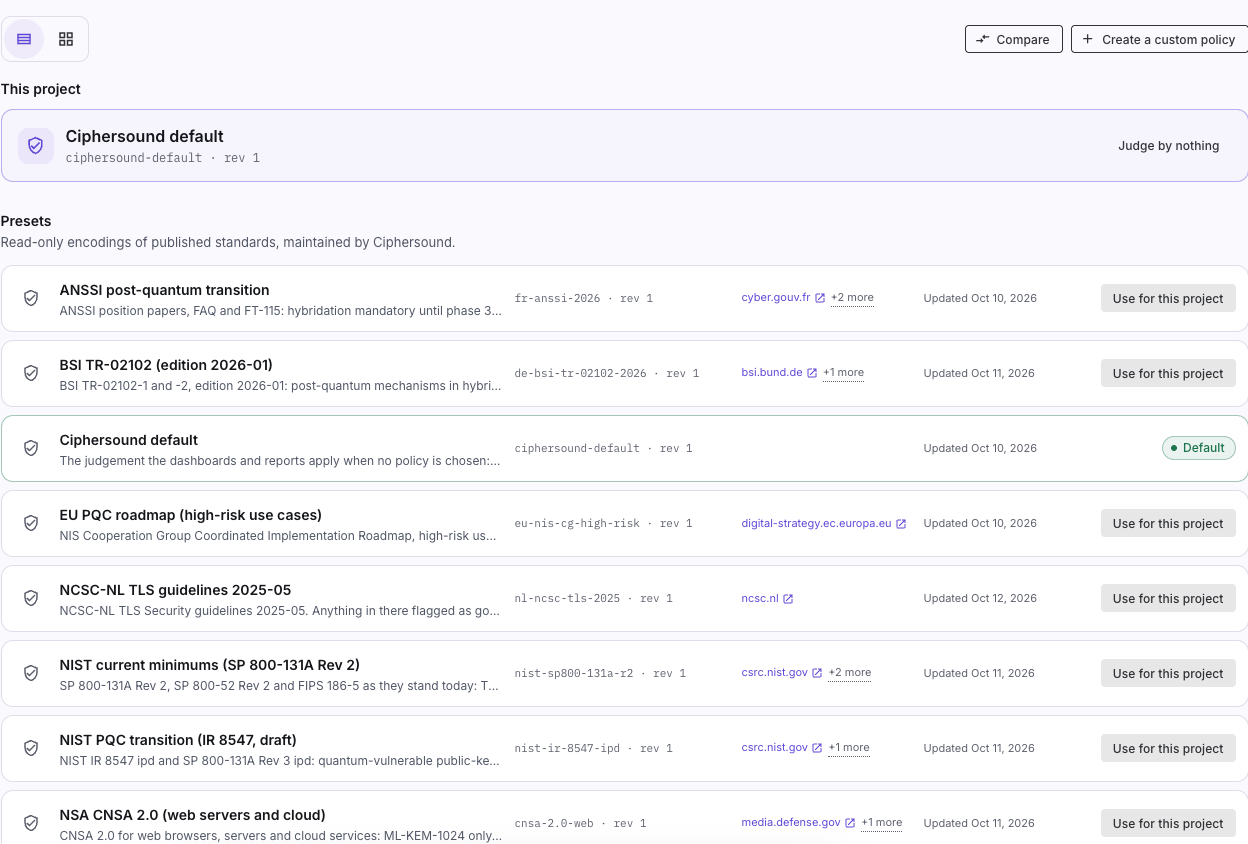
Scored against NIST PQC standards, CNSA 2.0 and Dutch NCSC policy.
Auditors ask for evidence, not intentions.
Boards and auditors increasingly ask for evidence of PQC readiness. A scan result holds up better than a self-reported questionnaire.
Repeatable
A scan-based readiness percentage you can re-run and defend, not a one-time self-assessment.
Easy to report
One overall figure that is simple to take to leadership and re-check on a schedule.
Mapped to standards
Every status is checked against the approved algorithm list from CNSA 2.0 and the NIST PQC standards.
What the report shows.
Every scan produces the same three things, so a result from last quarter reads the same as one from today.
Reporting and dashboardPer host
A ready or exposed status for each scanned host.
Checked against
Whether the negotiated algorithm is ML-KEM (FIPS 203) or a hybrid post-quantum group, or a classical algorithm those standards are meant to replace.
Overall
One readiness percentage across all scanned hosts.
How it is used in a review.
1
Add your public domains
Add the public domains in scope. Ciphersound checks them for you.
2
Cover internal hosts
Run the CLI inside your network for internal hosts, and upload the results to the same dashboard.
3
Fix what is exposed
Fix the hosts marked exposed.
4
Run it again
Run it again and take the new percentage to the review.
Is a readiness score a compliance certification?
No. It is an assessment, not a certification.
It is
A cryptographic posture assessment and PQC discovery tool. It shows which algorithm each scanned host negotiates.
It is not
A certifying body. “Ready” describes a host’s negotiated algorithm. It is not a claim of certified compliance with CNSA 2.0, CMMC or any other framework.
Use it as
The evidence behind your own review, not a substitute for one.
Frequently asked questions.
Does it cover cryptography beyond TLS?
Not yet. Today it is a focused TLS discovery tool, not a full cryptographic inventory.
What does it read from our servers?
Negotiated TLS handshake parameters only, never application data.
Does a scan satisfy a CNSA 2.0 or CMMC requirement?
No. It gives you evidence for your own compliance review. It does not certify anything.


Talk to Chris or Vincent about your setup.
A short call to review your domains and decide where to start.