SOLUTIONS
Cipherscan for enterprise security teams
Assess your PQC posture before legacy cryptography breaks vendor compatibility or certificate trust. Plan migration on your own timeline instead of a rushed one. Cipherscan inventories which TLS algorithms your services already negotiate, so your team can prioritize the systems that need attention before an external deadline forces the decision.
Turn an invisible cryptographic risk into host-level evidence you can plan around. Browsers, certificate authorities, and vendors are each moving toward post-quantum algorithms on their own timelines. When that shift lands, systems still running only classical cryptography can lose compatibility with little warning, knowing today which of your hosts still rely on classical algorithms lets your team plan the migration instead of reacting to it.
What counts as classical cryptography here?
Any TLS handshake that doesn’t negotiate ML-KEM (FIPS 203) or ML-DSA (FIPS 204), the two algorithms NIST standardized for key exchange and digital signatures in August 2024. See NIST PQC Standards for how the three released algorithms differ.
What you get
The exact algorithm each host negotiates
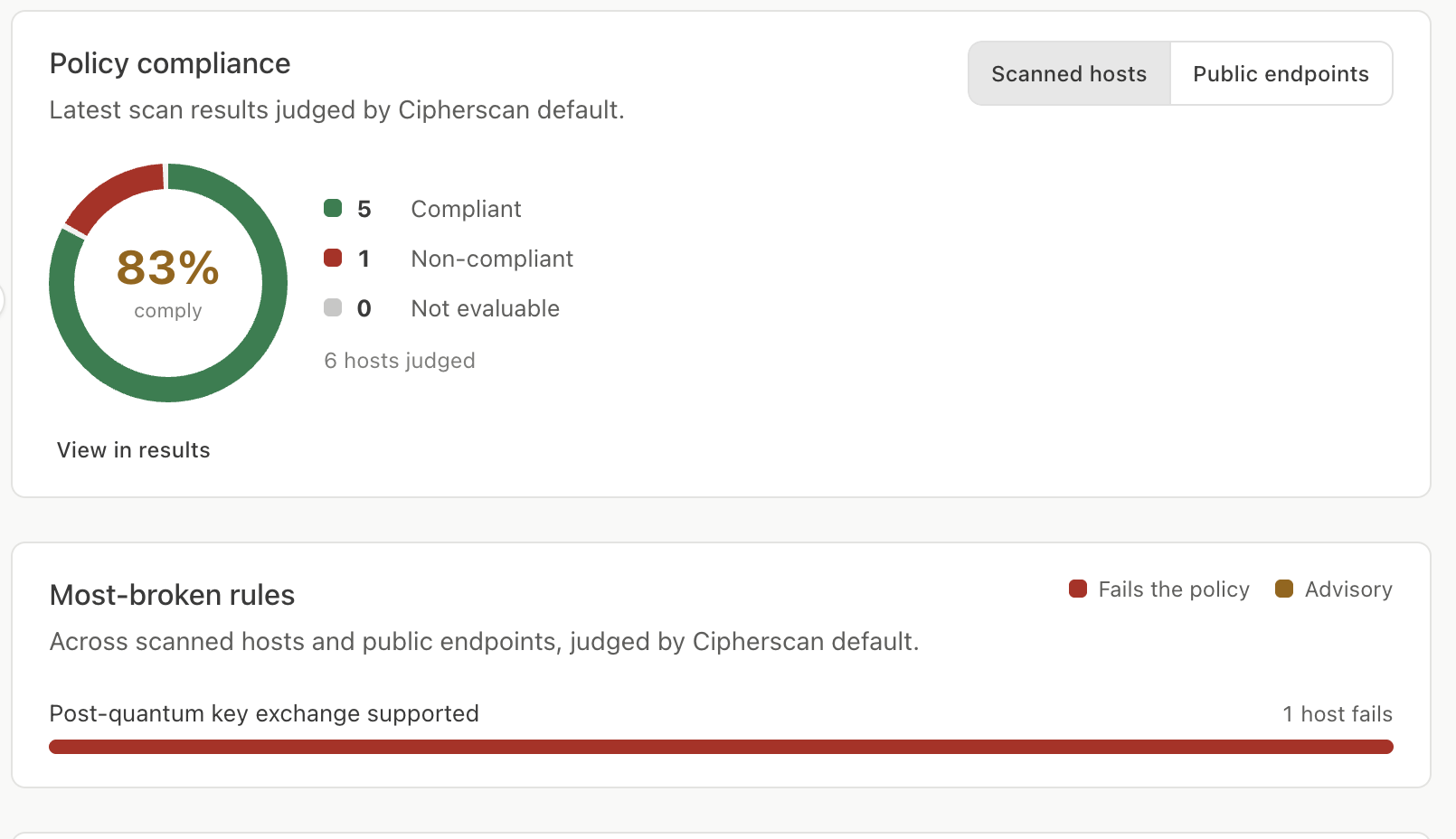
See exactly which TLS hosts are already PQC-ready and which aren’t, across your whole estate.
No agents, no infrastructure changes
Hosted scanning reads public handshakes; the CLI for private hosts runs on demand and installs nothing permanent.
A readiness score to track over time
Re-scan on your own schedule and watch the percentage move as hosts get remediated.
Does Cipherscan cover cryptography beyond TLS?
Not yet. Cipherscan today is a focused TLS discovery tool, not a full cryptographic inventory platform, it won’t catalog cryptography embedded in application code or third-party libraries. For most enterprise estates, TLS is still the fastest, highest-signal place to start a PQC baseline.
See your own exposure in seconds.
Written by the team behind Anvil Secure.